
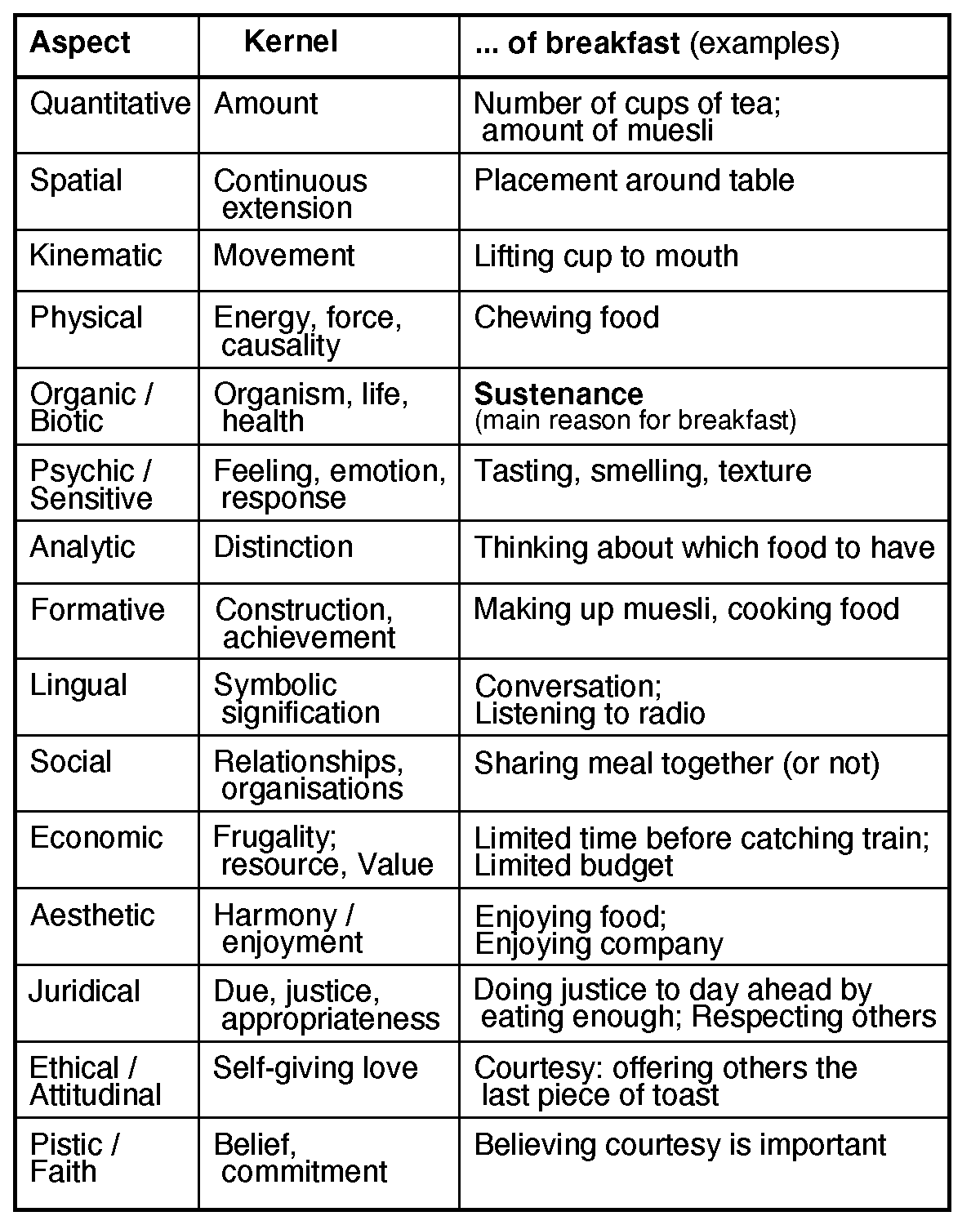
Figure 1, Table 1. Aspects of eating breakfast.
Presented at the University of Salford
12th March 2026
PART 1. The Complexity of Meaning in Real Life
PART 2. Going Deeper: About Subjects, Objects, Functioning and Norms
PART 3. Knowledge - Determining The Operation of AI
PART 4. Aspectual Analysis
5. CONCLUSION
References
APPENDIX - Aspects Sheets
Text Style: Smaller text is used for material that need not read, such as examples and notes, but it is often useful to do so. In most paragraphs, words in bold indicate the paragraph's main theme.
His ideas anticipateed those of many contemporary thinkers and even provide good philosophical grounding for them, sometimes offering a more systematic and intuitive way of tackling contemporary issues better than they do. These ideas include meaningfulness, the diversity and coherence of life, normativity (taking proper account of Good and Evil / Harm e.g. in AI), that theoretical thinking is limited and not neutral, that intuition is important, and many others.
This booklet was produced for a lecture / seminar given at the University of Salford Business School as part of a lecture module on AI in Business, so I have tried to relate all that I present to that very practical and important field. At the end, I present Aspectual Analysis: a way to capture the diverse meanings in a situation, which students may use in their studies and then their work and life.
Think about any situation in everyday life - having breakfast, travelling to work, looking at videos, buying and selling, relating to others, and so on. All exhibit multiple aspects, which are different ways of experiencing reality, seeing and understanding it. For example, breakfast has a biotic aspect, of feeding, an aesthetic aspect of enjoyment, an economic aspect of limited time before having to leave for work (as well as cost of food, or being short of an ingredient), and so on. I depict all this in Figure 1, naming 15 aspects of reality that Dooyeweerd discussed, and showing which aspect is relevant in various things, followed by a Table 1, which explains them. (During the lecture a different situation might be used.)
Figure 1, Table 1. Aspects of eating breakfast.
(Note: "pistic" is from a Greek word meaning faith, belief, commitment, etc. - what we really believe rather than just claim to believe. The physical aspect includes chemistry.)
Those who try to understand having breakfast - or any situation - need to be aware of the many aspects of it and understand one aspect at a time, then together. Column 2 of the table gives the kernel meaning of each aspect, which is irreducible to those of others, not explainable in terms of them, and hence no aspect should never be ignored.
Our having-breakfast activity is a multi-aspectual functioning in which each aspect is exhibited, often simultaneously: satisfying our hunger (biotic) while tasting it (psychical) and also enjoying it (aesthetic), and so on. Our functioning in later aspects impacts or shape our functioning in earlier aspects; for instance, what we eat (biotic) is shaped by our social situation, our budget, what we enjoy, our religious or ideological observance, etc.
Likewise for all the activities around AI and the functioning of the AI system itself. Those who want to understand AI must understand AI's many aspects - especially if AI is applied to breakfast! We will find knowledge of aspectual meaningfulness useful in understanding the content of knowledge bases, of aspectual functioning and Good, useful in understanding the activities of the humans involved in AI and their responsibilities, and aspectual laws and logic helpful in understanding where and why AI fails or succeeds.
(There are other parts of Dooyeweerd's philosophy, which we will not use, such as his epistemology, including his theory of theoretical knowing and science, his theory of entities his theory of progress, and the role of ground-motives in society; they are not covered here. To understand his entire philosophy see Chapter 4 of Basden [2019], Vekerk et al. [2026] or the Dooyeweerd Pages, especially the pages on Aspects of Reality.
Knowing something of Dooyeweerd's aspects can help us in at least four ways in complex situations. It can help us:

>CE Figure 2. Basic makeup of AI systems
The knowledge base encapsulates knowledge about how the AI App should operate in its intended application, based on various technologies, like inference nets, sets of logical statements, sets of associations, or so-called neural networks. The engine is designed and written to process the encapsulated knowledge according to the technology employed so as to respond to users (or the world).
The activity of each of these humans (and each might represent whole teams or groups of us) is likewise multi-aspectual.
GROUP OR PERSONAL EXERCISE 1. Discuss or think briefly: 1. How might each human affect the 'ethics' of AI, that is, contribute to good or bad the AI system eventually brings. 2. Then think about one of these human activities around AI and see how each and every aspect might be relevant in it. Hint: Refer to Table 1. You may take the aspects in order - top-down, bottom-up, or start with the most obvious (for example, the lingual aspect is meaningful in (a) writing computer instructions and code; (b) communicating with various people). Ensure that you cover every aspect.Then consider: Can you see the complexity of this? Did you find any surprises?
One is that such aspects imply both the possibility of a viewer, but also that what is seen is not purely subjective but is some reality about what is viewed. (Thus overcoming the subjective-objective divide that strangles much philosophical discussion.)
Another is that, just as in architecture the east aspect of a building cannot tell us what the south aspect is like, nor vice versa, so in wider reality, each aspect is irreducible to others and cannot be derived from others. So, for example, we cannot derive the biotic phenomena of life from physico-chemical phenomena, we cannot derive faith or ethics from psychology, and so on. (This shows up things like category errors.)
What Dooyeweerd did was to explore the philosophical nature of such aspects, not only their irreducibility but their inherent, fundamental interconnections and mutual inter-dependence, as modalities of meaning, giving us distinct ways of viewing/understanding reality, spheres of law, giving us an understanding of why functioning is possible and also guidance towards what is Good rather than Bad (e.g. what we eat might sustain us or make us ill; we might offer the last piece of toast or grab it for ourselves), and modes of being. Each aspect contains analogical 'echoes' of the others. Each aspect also give us a different basic kind of rationality or logic. For example, in quantitative rationality, if X = Y and X = Z, then Y = Z, but in social rationality it is not so: I can be friends with Jim and Joe but that does not mean Jim and Joe are friends with each other.
That each aspect offers its own distinct meaningfulness, laws and time is why Dooyeweerd's aspects are excellent for understanding a complex situations. They provide a sound foundation on which to build an analysis that separates out things clearly and without confusion. In considering breakfast [or whatever example was used during the lecture], we were focussing on kinds of meaningfulness. Now let us consider functioning and repercussions, which are made possible because of law and time.
All human activity exhibits all aspects in some way or another. We call it "multi-aspectual functioning". That is, we function in multiple aspects simultaneously. This does not mean that we are doing several things at once (such as juggling hoops while working out crossword puzzles, or listening to music while fixing the bicycle) but rather that even a single human activity is meaningful in several ways, and each of these ways is a functioning in a different aspect. For example, writing this,
- all these different aspectual functionings are simultaneously aspects of the activity of writing.
The first set of aspects are those that are necessary to the lingual act of writing - the functioning in an aspect depends foundationally on those earlier than it - then we have some aspects later than the lingual, which affect the 'style' of writing. When we analyse a situation we can consider aspects in any order (as we will do in Part 4. Notice also that some aspects appear more than once, sometimes having more than manifestation in an activity. What this implies for us using Dooyeweerd's aspects is that we should not be content with finding one manifestation of an aspect but think whether there are more. Our exercise of analysis is NOT a slot-filling exercise, but one of understanding complexity properly.
When we function in any aspect, there is usually also a second aspect involved, what we might call the target aspect of that functioning. We write (lingual functioning) about mathematics (targeting the quantitative aspect) or about galaxies (targeting the physical aspect) or about books (targeting the lingual aspect) or about faiths (targeting the pistic aspect). When we think, (analytic functioning) we might think about mathematics, galaxies, books or faiths (targeting those same four target aspects). And so on. Notice that the aspectual functioning can target even its own aspect: write about writing, think about thinking, etc.)
Example in AI: From their users' point of view, AI systems function in the following aspects at least:
- Lingual, in communicating with us;
- Formative, in structuring their replies, and also understanding the structure of our instructions;
- Analytical, in separating out concepts in our instructions and determining what is important;
- Psychically, when we see it in terms of mere stimulus and response;
- Physically, in consuming electric power and generating heat, in the processing of electric currents in its circuits.
It is not only humans that function in multiple aspects simultaneously; animals, plants and even non-living material does so too. For example a plant can live, grow, be healthy or diseased (biotic functioning), can exert force (physical), can move, can take up space (spatial) and can be a single organism (quantitative), just as humans can. An animal can do all these and also sense and react. But, Dooyeweerd says, the animal cannot function as agent in any of the later aspects: analyse, form, speak, socialise, economise, etc. (I personally believe thy might be able to do so in a limited way - but never as fully as humans can.) This can help us understand AI better; see below.
Example: Consider my activity of writing:
- I, the writer, am agent / subject in the lingual aspect, a lingual subject.
- My pen or computer is the object I employ in writing, hence a lingual object. The words and sentences are also lingual objects, of a different type; see below.
- The pen is a physical and kinematic subject (not object), in flowing ink onto paper.
- I also might be an economic object, if my writing and other tasks I do are for a firm employing me as a "human resource".
(Note that, though it is usually thought immoral to treat people as objects it is not necessarily so. It is only immoral and unjust when we ignore their full multi-aspectual humanity, transgressing what is due to people (juridical wrong), with unconcern and selfishness (ethical wrong), and treating people only as objects to suit our own wishes (pistic wrong).)
It is sometimes useful to take this one step further and differentiate two types of object. A prior object is one that exists before the subject-functioning occurs, such as the pen. A generated object is one that is generated as a result of the subject-functioning, such as the words or sentences I am writing.
Dooyeweerd's understanding of subject also allows for subject-subject functioning, such as two people in conversation (lingual subject-subject), buying and selling (social and economic subject-subject) or two rocks hitting each other (physical subject-subject).
Awareness of the difference between subject and object functioning - usually in a variety of aspects - can help us understand events and processes more clearly. Together, subject and object functioning may be called "meaningful functioning".
It also helps us understand responsibility more easily, especially when we want to ask who is responsible when AI goes wrong. There is responsibility in each aspect (lingual, social, economic, juridical, etc.) Ultimately, the main responsibility is with the subject, but the maker of the object also bears some responsibility too. We discuss these later.
(This might be omitted in the actual lecture / seminar.)
Can AI be like a human being (whether now or in the future)? This question has divided the AI community since the 1950s, and is still nowhere near resolution. Supporters of what is called "strong AI" answer "Yes: look at what it does" and while those who support "weak AI" answer "No: the computer is only a physical device." The battle presupposes either-or (especially when we think about future possibilities).
Dooyeweerd offers a more nuanced view that goes beyond either-or, which might open the way to a resolution. He treats the question differently by asking what we mean by "be like a". Do we mean AI functions as subject like a human does, or that AI functiongs meaningfully (as subject and object together) like a human does? If we consider only subject functioning, then we agree with weak-AI supporters; the computer can function as subject only up to the physical aspect, and only as object in the others. But if we consider meaningful functioning, we agree with the strong-AI supporters, in that it is meaningful to say "The LLM wrote my initial poem for me." This is shown in the following Table 2 (in which "A.I." refers to strong-AI and "Searle" refers to the AI guru John Searle who takes a semi-weak-AI view.
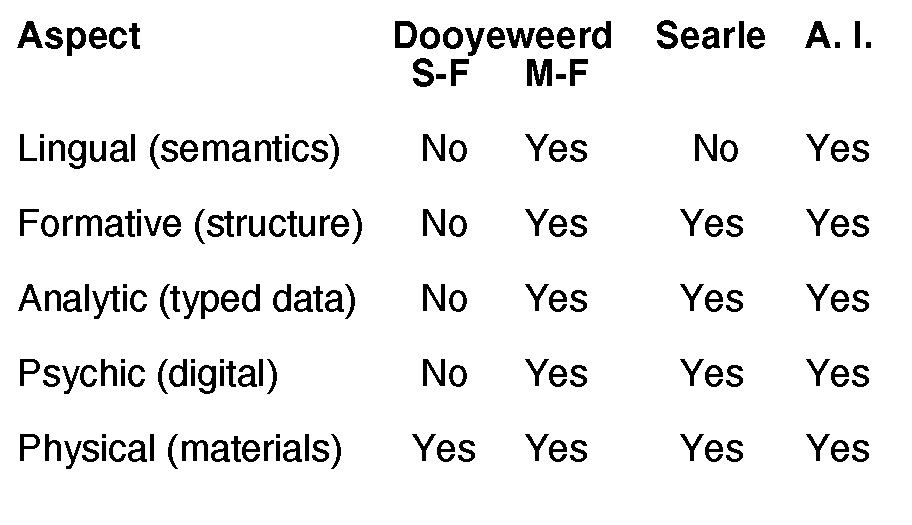
For full discussion of this, see Basden [2007], Chapter V, section 5.5, pages 207-220, in which the table is Table 5.6. It contains a full analysis of John Searle's views.
So, for example, the lingual repercussion of writing is that we communicate with other people and they begin to understand what is meaningful to us. The physical and kinematic repercussion is that ink soaks into paper (and might even soak through the paper onto the material underneath, as some marker pens do). The economic repercussion of might be that its income and costs increase by my writing.
Functioning in an aspect can be good or 'evil' (dysfunction) and repercussions can be good or harmful, according to whether we function in line with the laws of the aspect or go against them. That there is good different from bad, function different from dysfunction, etc. is called "normativity" of aspects. Normativity is a central concept in the Dooyeweerdian framework but a lot of theory ignores it. Yes normativity is something we cannot escape if we take everyday life seriously, as Dooyeweerd did. It is also a natural outcome of there being a law side to temporal reality. It is one area in which Dooyeweerdian thought offers considerable clarity when compared with other approaches. It ensures so-called AI Ethics is integrated with, not merely bolted onto, our understanding of AI.
The following Table 3 gives examples of good and 'evil' functioning in each aspect, and good and harmful repercussions.

Since we function in all aspects together our activity can be a mix of good and bad, good in some aspects and bad in others, and have correspondingly good and harmful repercussions. Our behaviour and its consequences is a mixture. This helps to overcome the problem of treating people as either goodies or baddies, trying to justify the goodies in spite of some bad they do, or to condemn the baddies in spite of some good they do. Example, a student using LLM to help write an essay is a lingual good, but if they are doing it for cheating, then this is a juridical bad. The good does not justify the bad; nor does the bad obliterate the good.
Knowledge of aspectual functioning and normativity can help guide users in their use of AI - and maybe when not to use AI. Especially when we consider indirect effects, such as climate change emissions, development of lazy habits, or lack of exercise and consequent obesity.
The final two aspects, ethical and pistic, sometimes called attitude and mindset, constitute what is often called the human heart. Attitude (ethical) can be either selfless and sacrificial or selfish, competitive and self-protective. Mindset (pistic) can be either humble commitment to truth and reality (good), or arrogant or idolatrous. This applies to all four of the humans in Figure 2.
The ethical and pistic are also the aspects that are most operative in society's culture (as in "This organisation has a toxic culture!" or "We need a change in society's culture if we are to solve the climate problem" [c.f. Speth [2013]). Culture deeply influences personal attitude and mindset (except in some courageous individuals) while the attitude and mindset of cultural influencers can either purify, or more often corrupt, the culture. And this can spread and permeate a culture - except perhaps when the culture is guarded by a good religion. (This is the structure-agency cycle of Giddens' Structuration Theory reinterpreted by Dooyeweerdian thinkikng.)
(No need to read: My Polemical Rant at the state of AI. Is the Global-North, materialist culture, in which AI is being developed and explored, corrupt? Mindset: Is AI being worshipped as an idol; is everyone expected to rush after it? Do we sacrifice many other good things on its altar? Whereas the climate crisis calls us to reduce our power generation, AI deafens us with its strident call for increased power generation - is this sacrificing the future? In a study, Manchester Chamber of Commerce found that most of the firms who are considering AI do not know what to do with it, but are driven by FOMO: Fear of Missing Out. Are large amounts of money and resource being wasted, which could have been used more profitably and beneficially? Attitude: Is all this exacerbated by the competitive attitude so common among nations and firms today? Idols often deliver the opposite of what they promise! Do not many politicians want the glory of being part of 'iconic' projects that actually waste money (such as the Bristol supercomputer designed to run AI for businesses, but which is being under-used)? Has AI really delivered fully its promised or expected benefits? Are not many of the individuals who lead massive AI-related businesses often selfish, arrogant individuals who are unconcerned about the damage being done, but only about their rivalry with other firms? How many are truly concerned about destroying people's livelihoods? Or are they only concerned about having their fun in the 'sport' of competing with other firms? Down in the 'lower' level of AI organisations, among the host of technical personnel, are not many fired by the 'thrill' of technological development, of achieving things in their work? And are they wilfully blind and deaf to most other factors like injustice to the poor and climate and environmental destruction? Am I wrong to even ask those questions? Ponder.)
In these two aspects, every human has some responsibility, but it is the AI deployers - the management who decide to indulge in an AI project - who have especial responsibility here. They are often the ones who deploy AI with false expectations and aspirations (pistic dysfunction), and with selfish or greedy or fearful motivations (ethical dysfunction). Such "issues of the heart" are often shared among all, often emerging as Groupthink or worse. And their attitude and mindset pervades all the team who are installing the AI, and the users who use it. Worship of AI, because it is fashionable, is especially problematic.
GROUP OR PERSONAL EXERCISE: Take one of the human multi-aspectual activities around AI depicted in Figure 2 (along with the results of Exercise 1) and discuss the good and bad of each functioning in each aspect and its good or harmful repercussions meaningful in each aspect, not forgetting the ethical and pistic.Consider: How might this help you in future analyses and discussions of 'ethics' of AI?
(This section might be omitted from the actual lecture or seminar.)
The above is all about the functioning of things; Dooyeweerd also provided a theory of things as such, and their types - that is, discrete things like pens or AI apps, or stuff like ink, bytes and knowledge. This understanding might not feature much in practical analysis, but it is important in addressing philosophical questions like whether and in what ways AI can be like humans (The AI Question).
To Dooyeweerd, all existence, all being, is grounded in meaningfulness, and all 'identity' of things as being of a particular types, may be understood by profiles of aspects that he called "structures of individuality". These are like laws that determine how a specific thing has the freedom to be of a certain type even though it might differ from other things of the same type.
Take the example of pens. A pen is a pen by virtue of its lingual aspect, and also its physical and kinematic aspects, and then its formative aspect, as follows:
Four aspects are what make something be a pen. The lingual emphasises its (object) functioning as a writing instrument, which differentiates it from, for example, the pipe in the ink factory down which ink flows to fill bottles of ink. The kinematic aspect differentiates pens from pencils, which deposit a chemical onto paper but without flow. The formative aspect differentiates pens from plant stems, along which liquids flow.
The structure of individuality comprises a few aspects, with different roles in the being of the thing: its main meaningfulness in reality (lingual for pen, biotic for plant, aesthetic for poem), earlier aspects that enable it to function in this aspect (physical and kinematic for pen and also for plant; economic, social, lingual, formative and analytical for poem), and the aspect by whose laws it came into being, other than the primary one (formative for pens and poems, and physical for plants).
Other aspects than these four can also be relevant in the being of a pen as a pen. For example, a good fountain pen might be a status symbol (social aspect). Also meaningful in the social aspect is that pens are often used to communicate with others, not just record information or thoughts. Neither of these social aspects are essential for its being a pen, in the way the lingual, physical, kinematic and formative aspects are.
GROUP OR PERSONAL EXERCISE: Discuss which aspects are essential, and which less essential, to the being of a LLM. You may take this to mean any and every LLM, i.e. the generic LLM, or a specific LLM such as ChatGPT. Work out at least:
- Which is the primary aspect - its main meaningfulness in reality;
- In which aspect(s) it works in order to operate as such;
- Which aspect(s) are important in its coming-into-being;
- Some non-essential aspects that might be relevant, and why.
Hint: It is useful here to understand the inner workings of the LLM, especially to identify the second set of aspects. An excellent explanation of ChatGPT is by ===.
Consider: Are there any surprises here? What difficulties did you get into when trying to identify these aspects? Might these four sets of aspects align with the four human activities in Figure 2?
Such knowledge is encapsulated in the knowledge base and the engine, the central technical part of AI by which it operates, in Figure 2. The knowledge base encapsulates knowledge of the specific type of application, and the engine, knowledge of the laws of relevant aspects. (In many AI systems, the distinction between knowledge base and engine is fuzzy.) Two people in Figure 2 are mainly responsible - the AI App developer and the AI algorithm designer.
Those two are the responsibility of the user; three others arise from deficiencies in the encapsulated knowledge in the knowledge base and engine, which are the responsibility of the AI App developer and the AI algorithm designer.
Awareness of Dooyeweerd's aspects can help reduce bias and error, because we can ask "Which aspects have we considered, and which not?" - and then give attention to the missing ones. It can all help us think more clearly about the knowledge we need. In knowledge elicitation this is obvious, but in MLAI, whole aspects are missed when choosing the training parameters.
This becomes more challenging in later-aspect applications.
The quality of KEAI depended on sensitive elicitation of knowledge from human experts and on close relationships of trust with those experts. Sadly, as AI became fashionable in the 1980s, many became knowledge engineers who would be less careful than this required, so that many AI systems did not work well, and AI gained a bad reputation in the 'real world'. (This is partly what led to AI's demise for a couple of decades.)
Quality of MLAI seems at first sight to depend only on the training data and not on such human skill and attitude, the need for which is, apparently, bypassed by looking for patterns in masses of data. But that is misleading, as discussed in An Integrated Understanding of AI. It has been found that, though the bulk of the knowledge base might be filled with such patterns, this needs a lot of refining by human activity, which requires knowledge elicitation skills and care which we explored in the 1980s - for example by GPT adding a social database and by employing low-paid people in Kenya to add training about which material is offensive so that it can be removed from what it delivers to the users.
Both KEAI and MLAI depend on good analytical functioning of making appropriate distinctions and choices, and KEAI depends on good formative functioning of structuring the pieces of knowledge thus obtained. In MLAI, this structuring is carried out not by human formative functioning directly, but by the manipulation of parameters in the machine learning algorithms (which are a proxy for the human functioning. It is the responsibility of the AI algorithm designer to ensure that this proxy is adequate, as well as the detecting of patterns works well.
GROUP OR PERSONAL EXERCISE: Research to find out what refinements have been added to a LLM (Claude, Gemini, GPT, etc.) and identify which aspectual laws or meaningfulness makes them necessary.Consider: How much effort needs to go into such human-elicited refinements? (Read up on refining the trained knowledge bases, if you have not already done so.)
In general, the engine needs to encapsulate knowledge of the basic laws and meaningfulness of every aspect that might be relevant to the application for which a knowledge base is being developed. Thus, for Chess, AI must have a good 'knowledge' of the laws of the spatial aspect and GPT, of the lingual aspect, and for a law advisor, knowledge of the juridical.
However, it is more complicated than that because Chess AI must have some 'knowledge' that is meaningful in other aspects, such as of limited movement (part of kinematic aspect) human goals and strategy (the formative aspect). GPT must have some 'knowledge' of the formative aspect (structure of language), analytical aspect (distinguishing words, phrases and part-words from each other: vocabulary etc.), psychical aspect (especially for colour in pictures), spatial aspect (in pictures), social aspect (it has a database of people and their relationships), and a few others. Such we will call the secondary aspects, because they are there to support its operation in its main aspect. Some AI systems might have more than one main aspect; we need not be dogmatic about which are primary and secondary; the idea of primary aspect is here to help us understand.
How can ChatGPT write essays, for example? ChatGPT analyses user's instructions or questions, and generates the text of the essay. Both operate according to the laws of the lingual aspect, which are encapsulated as host of probabilistic degrees measuring how much each word is meaningful in more than 12,000 ways. With this, ChatGPT's algorithm is designed to perform conceptually simple mathematical matrix operations by which the relationships among words can be reasoned about, for example which words tend to follow which in various contexts and which words are synonyms for each other. [FOOTNOTE: How ChatGPT works]. Sadly, it is not divulged what those 12,000 ways are but we may expect each to represent a different permutation of the fifteen aspects.
(A Story: A group in a major company (I am not at liberty to give details!) used AI to write a grant proposal, and it came up with 5 pages. They wanted something longer, so it came up with a 10 pager. Still not long enough. Eventually to gave nearly 200 pages and they were satisfied. But what it said was rubbish. Every sentence was well formed and seemed to make sense in itself but the whole just did not make sense. Nevertheless, senior management looked at it briefly and signed it off!
This massive knowledge base was constructed by ChatGPT reading vast amounts of Internet content (175 billion pieces as of November 2023). Since all these pieces are results of humans functioning in the lingual aspect (consciously or subconsciously), they together express human beings' functioning in the lingual aspect. In 1980s AI, the laws of the lingual aspect would have to be elicited and encapsulated in the knowledge base explicitly and manually - a lengthy project! However, as it turns out, LLMs acquire extra modules that refine them - which may be see as engine modules that encapsulate laws of other aspects, such as the social and juridical.
(A story: In earlier days of MLAI, when AI was being trained to analyse xray slides, and achieved nearly 100% accuracy. It was found that what it recognised was not the the presence or absence of cancer in the slide, but of a red dot that expert staff had already put on the corner of the slides to mark the slide as probably indicating cancer. The AI merely looked for the red dot, and hardly took the content into account at all! Moral of story: Make sure that the AI is not finding things you don't expect!)
The laws of earlier aspects are easier to encapsulate in a knowledge base reliably. for two main reasons. One is that the laws of earlier aspects are more determinative so that, for example, 3 + 4 is always 7 (law of quantitative aspect), whereas a question might be answered is several different ways (lingual aspect).
The other reason is that the laws of earlier aspects act as a foundation for those of later aspects, so, in principle, encapsulating knowledge of a later aspect requires us to encapsulate not only its laws but laws of all earlier aspects too. Laws of physics depend on three earlier aspects, those of lingual, on eight. Moreover, the middle aspects of human individual functioning are influenced by later aspects too, which can also need encapsulating (e.g. ChatGPT's social database, and the knowledge to exclude offensive material). The kinds of law meaningful in each aspect is shown in Table 4, together with AI applications mentioned in Basden [2025] (Some Wisdom About AI) for which each is the primary aspect.

Therefore AI tends to work more reliably, and have more successes, in applications governed by the earlier aspects, than those governed by later aspects. X-Ray analysis (spatial aspect) is more reliable than is ChatGPT (lingual). Those who extrapolate from current successes in AI to "AI will soon be able to do everything" fundamentally misunderstand AI.
GROUP OR PERSONAL EXERCISE. Take three or more uses of AI that you or the group have made and think or discuss what were the main aspects that made each use of AI meaningful?Consider: Given the different aspects, how much reliance should I put on each use of AI?
(This section might be omitted in the actual lecture / seminar.)
Fully complete and accurate knowledge is what is required for AI on which we wholly depend, such as AI that replaces humans or makes decisions for us. But full reliability is not always needed where AI assists or stimulates humans rather than replaces humans. Basden [1983] lists eight roles that I found during my work in AI in industry.
Roles in which AI assists or stimulates humans require transparency and understandability of the knowledge encapsulated in the knowledge base because the user must be able to understand why and how the AI system gives the advice it does. Unfortunately, that is very difficult or even impossible to achieve in MLAI because its very working depends on all the knowledge being mixed together into the numeric parameters such as the dimensions of each concept. In KEAI this mixing does not occur and each piece of knowledge and its relationship with other pieces is represented separately from the others. (In the 190s, we created several expert systems that made good use of KEAI's transparency.)
It may be that some proxy for transparency will be found for MLAI but if so it is likely that it would be assisted by Dooyeweerd's aspects used in knowledge elicitation.
We will now discuss aspectual analysis, by which the knowledge to develop knowledge bases and engines may be obtained, and also that required by users and deployers to use the AI beneficially - all four humans in Figure 2.
Whether using knowledge elicitation or machine learning, we start the same way: find out the kinds of things that are meaningful. This can be done by analysing texts, interviewing or observing, or any other ways. Here are three ways that have been found successful. After that, KEAI and MLAI differ.
For more detail, see the article on Aspectual Analysis.
Texts (or video or audio recordings) often give a good idea of what is meaningful in a domain to which we might apply AI. We go through the text phrase by phrase, asking "Which aspect(s) make each piece meaningful?" And, where appropriate, label them Good or Bad.
Mitev's [2001] gave the following report of the failure that was the early SNCF (the French national railways) Socrate rail ticketing system:
"Technical malfunctions, political pressure, poor management, unions and user resistance led to an inadequate and to some extent chaotic implementation. Staff training was inadequate and did not prepare salespeople to face tariff inconsistencies and ticketing problems. The user interface was designed using the airlines logic and was not user-friendly. The new ticket proved unacceptable to customers. Public relations failed to prepare the public to such a dramatic change. The inadequate database information on timetable and routes of trains, inaccurate fare information, and unavailability of ticket exchange capabilities caused major problems for the SNCF sales force and customers alike. Impossible reservations on some trains, inappropriate prices and wrong train connections led to large queues of irate customers in all major stations. Booked tickets were for non-existent trains whilst other trains ran empty, railway unions went on strike, and passengers' associations sued SNCF."
So we go through this, identifying which aspect(s) make each phrase meaningful, e.g. "sued SNCF" is juridical. Collecting these into their aspects, we obtain the following Table 5:
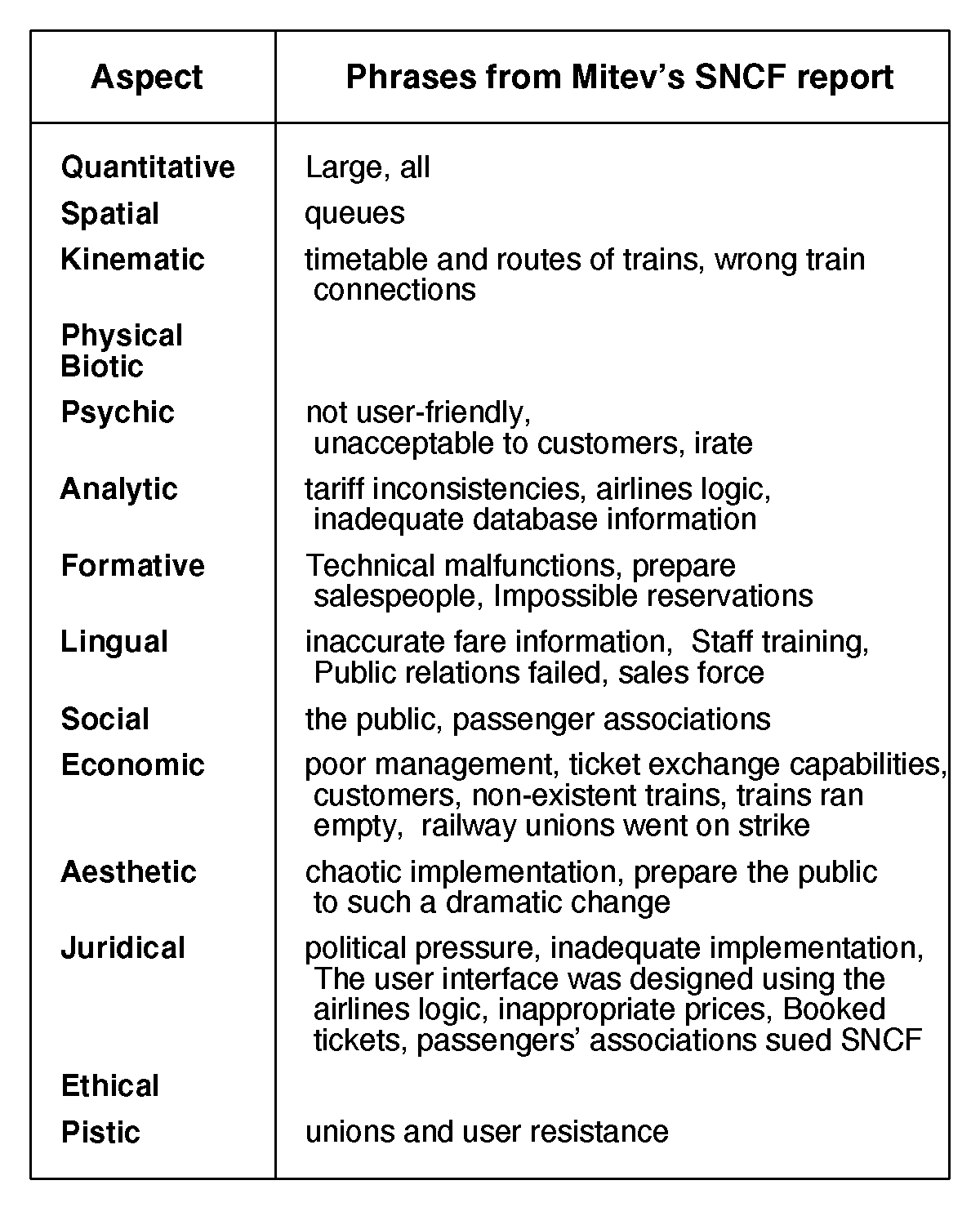
Notice how most of the pieces are about functioning: something happening. This is often more useful than trying to analyse things, which are more static and lack normativity. It is often a good idea to distinguish the aspect of functioning from its target aspects, though we have not done so there. And to distinguish good from bad.
Mike Winfield [Winfield 2000; Winfield et al. 1996] developed the Multi-aspectual Knowledge Elicitation (MAKE) method, an interview technique that is based on Dooyeweerd's aspects and inter-aspect coherence.
Typically, a MAKE interview involves an interviewer and a participant who has expertise in the topic and lasts around one hour. The interviewer guides the participant in explaining their expertise with non-leading questiohns. Winfield devised seven steps to guide it:
It is the interviewees who are in charge of identifying aspects that make their concepts meaningful, not the interviewer, who avoids leading questions. Useful prompts are, "Why?", "When is this not meaningful?" and "What else?". As Winfield's discussions proceeded, he would draw an aspectual map expressing the concepts that emerge, their relationships and the aspects that make them meaningful, and check it with the participant. Figure 3 shows a simple example.
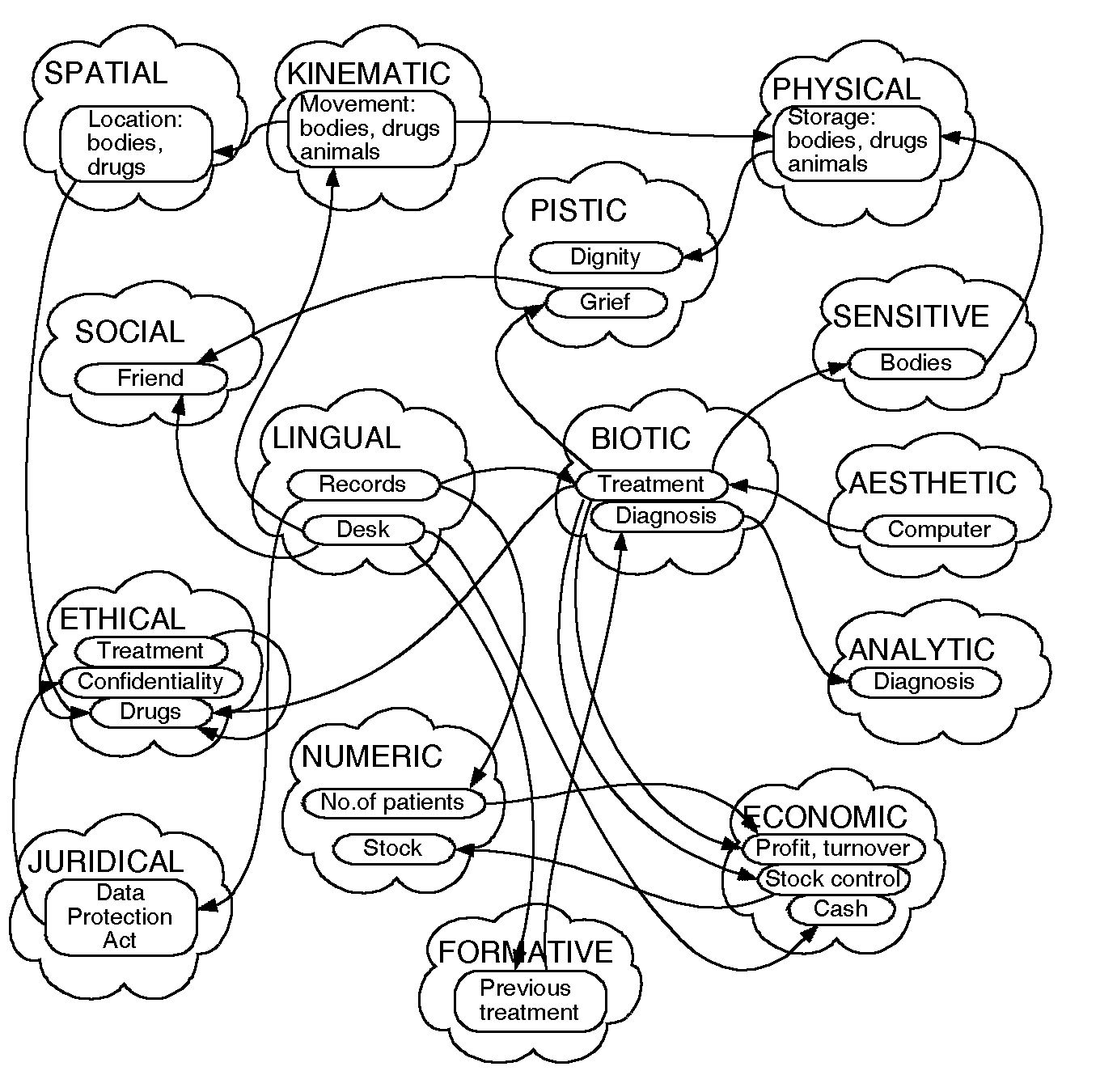
Figure 3. Typical aspectual map (MAKE).
Winfield applied this to six case studies (tree planting, sustainability, veterinary practice, Islamic food laws, youth advice and management of a local housing business unit). Some of his students were involved as interviewers. Many of the interviewees found the process valuable because it helped them think in new ways.
Several capabilities of MAKE are discussed by Winfield [2000] and Winfield & Basden [2006], and summarised in Basden [2019, §11-6.4].
Whereas some interviewees are used to being interviewed and thinking conceptually ("Which aspect makes this meaningful?", as in MAKE), many are not. The interview situation can be perceived as threatening, especially for those from less privileged backgrounds. So there is a need for supportive interviewing techniques that help interviewees to express what they really believe, know or feel, and the rich nuances therein.
So Kane used a different approach: guide students to go through aspects one by one, asking, "What issues can you think about that are meaningful in this aspect?" The students could go through in any order they wished. Towards the end, the interviewer prompts the interviewee on aspects not yet mentioned, but without pressure to respond. Though we might expect such a linear, 'slot-filling' approach to be constraining, in fact (surprisingly) the interviewees found it liberating, in that they found they were speaking about issues they would normally consider embarrassing or too trivial to mention. Many thanked Kane for this at the end of the interview.
In neither do we use the material directly, but in both it can be thought about. To use the above in knowledge elicitation, one would take the collected pieces and ask "Why is each important?" and "What factors ensure that it does right not wrong?" We might, for example, think about how each might infer or cause other ("Which other factors might this lead to?"), for example
"wrong train connections led to large queues of irate customers"
and then expand this by asking questions like
This reveals inferences and causalities among factors, by which the AI system can operate. Since very little KEAI occurs today, we will not say more here, but see how it can help MLAI. For more, see Attarwala & Basden [1985].
In MLAI, the collected factors can inform us of (a) which datasets to obtain and how, and (b) which parameters to use in training the data. Often the fourth question above is useful (but so are the others).
For example, "What is a wrong train connection?" This should spur us to think about what is wrong and what is a connection. Train connections must be in the same station and without inordinate walking. "Wrong" might include trains going to the wrong places, trains that do not stop at the intended destination, time between trains being too short, or too long, and so on. Such things might be meaningful in other aspects.
Almost every issue listed above in Table 5 must be considered. Each might give us several parameters to apply to selecting parameters for applying to the training data. Maybe a hundred or more parameters might arise from that table. Then aspectually analysing other texts or interviews will give us many more.
Missing aspects: Notice also how there is nothing in Mitev's report that is meaningful in the ethical aspect; we should ask ourselves whether there might be anything. (Mitev might have missed it.) So look for datasets where the missing aspect(s) are likely to feature.
In addition, the knowledge elicited by aspectual analysis might indicate aspects that are not easily covered, and thus stimulate us to consider whether each might help us consider what things might need refining the knowledge, before a disaster forces refinement on us. It may be that, for LLMs, where the main engine works by the laws of the lingual aspect, then a refinement module might be called for for every other aspect (such as the social and juridical in the case of GPT, as already mentioned).
GROUP OR PERSONAL EXERCISE. Obtain an article or video on how to do some task that requires some expertise. (Several might be made available at the lecture / seminar.) 1. Analyse the phrases as above, to identify whicn aspects make each meaningful. 2. About each issue, ask "What is X?" as we did for "wrong connections" and also "Why is it important?" From this develop several other factors or parameters that might be useful to guide machine learning.Consider: In what ways was this helpful and not?
Do not forget the ethical and pistic aspects (attitude, mindset) neither at the individual nor societal / communal levels, because they help us understand the deeper influences, which, often unseen and overlooked, can wreck an AI project or make it successful. At the societal level they help us understand the wider and more 'macro' issues of the future of AI, society and planet.
Basden A, 1983. On the application of Expert Systems. Int. J. Man-Machine Studies, 19:461-477. Available at "http://kgsvr.net/andrew/-p/ai/Basden83-ApplicES.pdf".
Basden A. 2007/8. Philosophical Frameworks for Understanding Information Systems. Hershey, PA, USA: IGI Global (IDEA Group Inc.). ISBN: 978-1-59904-036-3 (hbk), 978-1-59904-038-3 (ebk).
Basden A. 2017/2018. Foundations of Information Systems: Research and Practice. Routledge. ISBN: 978-0-367-870-300 (pbk), 978-1-138-79701-7 (hbk), 978-1-138-75748-3 (ebk)
Basden A. 2019/2020. Foundations and Practice of Research : Adventures with Dooyeweerd's Philosophy. Routledge. ISBN: 978- -103-2086-927 (pbk), 970-1-138-72068-8 (hbk.) 971-1-315-19491-2 (ebk).
Basden A. 2024. An Integrated Understanding of AI. Guest lecture given at Univesity of Salford Business School. Available at: "http://dooy.info/using/uai.html"
Basden A. 2025. Some Wisdom About AI. Lecture given at Univesity of Salford Business School as part of the AI in Business module. Available at: "http://dooy.info/using/wai.html"
The Dooyeweerd Pages. A website discussing Dooyeweerd's philosophy. Available at "http://dooy.info/".
The Dooyeweerd Pages. On "Aspects of Reality". Available at http://dooy.info/aspects.html.
The Dooyeweerd Pages. On "Aspectual Analysis". Available at http://dooy.info/aspanal.html.
Mitev NN., 1996, "More than a failure? The computerized reservation systems at French Railways", Information Technology and People, 9(4):8-19.
Mitev NN. 2001. The social construction of IS failure: symmetry, the sociology of translation and politics. pp.17-34 in Adam A, Howcroft D, Richardson H, Robinson B (eds) (Re-)Defining Critical Research in Information Systems, University of Salford, Salford, UK. See also Mitev [1996].
Speth JG (Gus). 2013. Shared planet: Religion and Nature, BBC Radio 4, 1st October 2013. Also in Common Cause Newsletter.
Verkerk M, Glas G, Sierksma-Agteres S. 2026. The Intellectual Legacy of Herman Dooyeweerd 1894-1977: A Hopeful Philosophy for our Time. Springer.
Winfield MJ, Basden A, Cresswell I. 1996. Knowledge elicitation using a multi-modal approach. World Futures, 47, 93-101.
Winfield MJ. 2000. Multi-Aspectual Knowledge Elicitation. PhD Thesis, University of Salford, UK.
Winfield MJ, Basden A. 2006. Elicitation of highly interdisciplinary knowledge. pp. 63-78 in S. Strijbos, A. Basden (eds.) In Search of an Integrated Vision for Technology; Interdisciplinary Studies in Information Systems. Springer, London, UK.
notes===== ghere 3 March 2026
[FOOTNOTE: How ChatGPT works]
This page, "http://dooy.info/using/dooyai-uos.html",
is part of a collection that discusses application of Herman Dooyeweerd's ideas, within The Dooyeweerd Pages, which explain, explore and discuss Dooyeweerd's interesting philosophy. Email questions or comments are welcome.
Written on the Amiga and Protext in the style of classic HTML.
You may use this material subject to conditions. Compiled by Andrew Basden.
Created: 3 March 2026
Last updated:
APPENDIX - Aspects Sheets
>FO Off
>op
ASPECTS SHEET
To be used in analysis
__________________________________
Quantitative: amount and discrete quantity


__________________________________
Spatial: continuous extension


__________________________________
Kinematic: movement


__________________________________
Physical: energy, mass, forces, etc.


__________________________________
Biotic: life functions


__________________________________
Sensitive / Psychic: sensing, response, feeling, emotion


__________________________________
Analytic: distinction and clarity


__________________________________
Formative: our ability to shape things, concepts, organisations, etc., and with technology and history


__________________________________
Lingual: symbolic signification: documentation, programming, etc. and providing the basis for communication


__________________________________
Social: inter-personal relationships and social institutions and structures


__________________________________
Economic: frugality, resources, and management of these


__________________________________
Aesthetic: harmony (as in music), play, fun, interest, surprise, etc.


__________________________________
Juridical: 'what is due' to all, and legal rules and enforcement


__________________________________
Ethical: self-giving, generosity, going beyond what is due


__________________________________
Pistic / Faith: faith, vision, commitment.
>pa
ASPECTS SHEET
To be used in analysis
__________________________________
Quantitative: amount and discrete quantity


__________________________________
Spatial: continuous extension


__________________________________
Kinematic: movement


__________________________________
Physical: energy, mass, forces, etc.


__________________________________
Biotic: life functions


__________________________________
Sensitive / Psychic: sensing, response, feeling, emotion


__________________________________
Analytic: distinction and clarity


__________________________________
Formative: our ability to shape things, concepts, organisations, etc., and with technology and history


__________________________________
Lingual: symbolic signification: documentation, programming, etc. and providing the basis for communication


__________________________________
Social: inter-personal relationships and social institutions and structures


__________________________________
Economic: frugality, resources, and management of these


__________________________________
Aesthetic: harmony (as in music), play, fun, interest, surprise, etc.


__________________________________
Juridical: 'what is due' to all, and legal rules and enforcement


__________________________________
Ethical: self-giving, generosity, going beyond what is due


__________________________________
Pistic / Faith: faith, vision, commitment.


------------ end